�
| � | |
| � |
 |
��
Good Practice Guide
�
Contents
�
A.� ����� Introduction
�
�
�
D.� ����� When�s the best time to introduce sustainability to your students?
1.����� Sustainable design at Key Stage 3
2.����� The Sustainable Technology Education Project (STEP)
3.����� Sustainable design at Key Stage 4
4.����� Introducing it in Year 12
�
E.� ����� How can sustainability be first introduced to students?
1.����� Raising awareness
2.����� Learning through products
3.����� Getting from outside speakers
4.����� To start with a presentation or not?
5.����� Using quotations
�
F.� ������ Choosing projects � what�s been useful?
1.����� Key messages
2.����� Should all students be working on the same context?
3.����� Should students be restricted to SDA contexts?
�
G.� ����� Making the best use of resources
1.����� Using the Teachers� Handbook
2.����� www.sda-uk.org
3.����� Help from the partners � Practical Action, CAT, Loughborough
�
H.� ����� How can enthusiasm be maintained throughout a project?
1.����� Lots of little prompts
2.����� Using every opportunity
3.����� Getting in outsiders
4.����� Extra-curricular activities
5.����� Maintaining the right environment
6.����� SDA � optional or compulsory?
7.����� And finally a warning �
�
I.� ������� Using the Design tools
1.����� Do not assume a one-size fits all approach!
2.����� Are the tools needed?
�
J.�������� Assessment
1.����� Using the assessment sheets
2.����� Using the criteria and checklists for formative assessment
3.����� Using the DA website
4.����� Relating to exam board assessment schemes
�
K.������� Extra-curricular help
�
L.�������� Culture in the department and the school
1.����� Encouraging a sustainability culture
2.����� Linking with other external initiatives
3.����� Other ways of linking with internal initiatives
4.����� Departmental culture
�
M.������� So what does it all add up to?
�
�
Section A.
�
Introduction
�
Who�s it for?
The pack is intended for teachers with an interest in sustainability. It assumes that there is no need to justify the inclusion of sustainable design to D&T teachers. It does, however, provide opportunities for teachers to run activities with their students that suggest reasons why sustainable design is should be on the agenda.
�
It is a self-help guide to becoming an effective teacher of sustainable design. It is based on experiences and reflections of teachers who were introduced to sustainable design through training provided by ITDG (now Practical Action), CAT and Loughborough University for the Sustainable Design Award. The experience of those teachers is intended to provide examples of what has worked for them (and what hasn�t) in order to encourage like-minded teachers to try it for themselves.
�
We asked a consultant from York University to visit a sample of schools in England and Wales where teachers have actively used sustainability in their teaching. The sample was not devised scientifically. Our intention was to seek out what teachers had found helpful so it could be shared with colleagues elsewhere. A total of 16 schools were involved.
�
�
�
1. IT GETS STUDENTS THINKING.
�Students become aware of the moral responsibilities of designers.� Teachers suggest significant changes in student attitudes towards design and consumption. They report evidence of more students asking questions like, �Should we be making this product at all?� and �How will this product affect our lives?�� The aim of the project is to help create a generation of young people who are informed decision-makers in relation to their consumption and designing lifestyles. That�s happening in some schools!
�
�
2. SOME STUDENTS ARE MORE MOTIVATED BY INVOLVEMENT IN SDA
It�s only some, of course but there some teachers say their less able students can move up a grade because they think what they�re doing is worthwhile. Some have found involvement in projects from developing countries motivating, others stick to UK projects in the belief it�s only projects of immediate relevance that motivates their students.
�
�
3. IT�S MOTIVATED TEACHERS
Again, it�s only some � and there are plenty of cynics left but those with an initial interest in sustainable design have found it adds a new dimension without adding more work. Some teachers suggested it had had a really good effect on teamwork with their departments.
�
�
4. IT�S IMPACTED ON THE COMMUNITY
Where schools have managed to find a local client with a real design brief, they have found that their students have influenced the client towards a more sustainable way of thinking.
�
One school linked up with a local tourist attraction. The client was looking for sustainable, appropriate seating for visitors using the site. The teacher and staff visited the site, looked for appropriate vantage points and each of the students designed sustainable seating appropriate to the vantage point of their choice.
�
The teacher reported, �There has been an interesting effect on the client who is now thinking much more about sustainable development. This is one of the unexpected consequences.� It is easier for people who are thinking about SD (i.e. our students) to get into the minds of those who are not (i.e. the client) than it is the other way round � that is if the client is not thinking about sustainability it is harder for him to understand what we are on about.� Our understanding of this has helped to make for useful interaction between the students and the client.� He is now enthusiastic about sustainability.� The school can change the way that people think.� The client has realised that the more cost-effective solutions to problems are also the more sustainable.�
�
�
�
1.���� Sustainable design is not a topic!
�
The most important thing to remember about sustainable design is it is not a topic!� Those schools that try to teach a block on sustainability, followed perhaps by a block on materials, and a third on ergonomics, find that students forget what they have learned.
�
The road to success is to let sustainable design thinking permeate everything.� It is a background approach, a frame of mind.� It needs to be brought up again and again and again. The motto for the sustainable design teacher has to be drip-drip-drip.
�
�I don�t teach sustainability as a lesson.� I don�t think it would work as you would come to remember just a part of it.� But if you do bits of it throughout your courses, sustainability is coming up all the time and it�s that input into the minds of children that works.� Drip-drip-drip has more impact.� It is reinforced all the time.�
�
Every design decision can be � should be � informed by thinking of the consequences both now and for future generations.
�
When we discuss materials we always look at the environmental impact across the whole life cycle of the product.� An AS student wanted to make a small table for a toddler.� Should he use MDF or ply?� In the end he chose 15mm redwood boards from a sustainably managed forest approved by the Forestry Stewardship Council.� They had not generated toxic emissions beyond the transport. While making decisions about materials we need also to look at the impact of processing that particular material.
�
Every time a product is disassembled and analysed there can be discussion of the latent energy embedded in the manufacture and disposal of each component, as well as its toxicity and use of scarce or non-renewable resources.� An AS student did a detailed analysis of a jug kettle to see how it could be made more sustainable.� Using the Ecoindicator[1] he could see how changing some materials would make it less damaging.� He also found that it was almost impossible to disassemble and that for all the recycling arrows on the product it was impossible to dismantle. But the main finding was that if the kettle was redesigned so that he could boil up as little as 250 ml at a time it could cut the environmental impact by over 50%.� <Photos available>
�
At the start of every other weekend, one teacher asks each of her students to find a product that is particularly good or bad from the perspective of sustainable design, and to give a one minute presentation about it one the Monday morning.� One student brought in some fair traded, organic cotton jeans from Hug (they looked as good as more famous designer brands but cost twice as much � this generated a discussion about whether it was worth it).� Another student brought in a Hoky carpet sweeper � bagless, human-powered, goes on for ever.
�
One teacher from a rural school in Wales says: �We build on the students� experiences.� Many come from farming families.� So we look at water � how the water cycle operates, what the water table is.� Then we discuss what happens to with the sheep dip.� Farming children are very aware of environmental issues��
�
There is a huge reservoir of personal knowledge among the students that can be used as building blocks for developing a sustainable design mentality.� They can discuss day-to-day issues such as the price of petrol, or what happens to a tree that is cut down, or why the school buys Russian ply rather than Far Eastern ply, or why meat grown on a farm down the valley travels 1,400 miles before arriving back at a supermarket around the corner.�
�
These issues can be brought into the classroom for few minutes � as can topical issues from the news. �For example a government minister had been questioned on TV news the night before as to why there was no extra tax on aviation fuel, when everyone knows that flying is a substantial cause of global warming.� This discussion was just before the summer holidays when many of the class, and the teacher, were about to fly off to somewhere warm and sunny.
�
�
�
2.� Make the physical environment reflect sustainability
�
Sustainability principles and sustainable design must be reflected in the physical environment in which students work.
�
a. One school has quotations from newspaper articles, sustainable design books etc up on its walls. �The Independent� has regular articles featuring the impact of current lifestyles in terms of waste, landfill, energy use, travel, food miles. These are photocopied and put in the workshop. See for example http://news.independent.co.uk/environment/article353700.ece which is an article on the UK government�s initiative to support small-scale, local electricity generation from renewable energy sources.�� To see what is available go to http://www.independent.co.uk/ and type in the search box �global warming or �sustainable development� and hundreds of articles will appear.
�
b. Another school uses the same principle, but uses a PowerPoint presentation early in the year with its AS and A2 level students.� This focuses on case studies e.g. the redesigned Yellow Pages that reduced the number of pages due to a better font and better graphic design generally, Datchefski's chairs, pencils from recycled PS, Blue Marmalade products (Blue Marmalade is a design consultancy in Scotland that focuses on sustainable design), Bedzed.� See Carol�s PowerPoint in separate file (image 1)
�
c. Several schools display students� work which shows good sustainable design. They find that younger students can be encouraged by looking at what their peers in older year groups have managed to achieve.� See photos from South Craven in separate file (image 2).
�
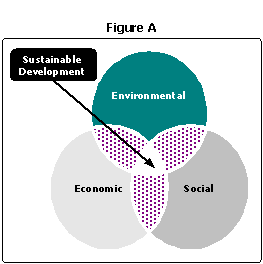
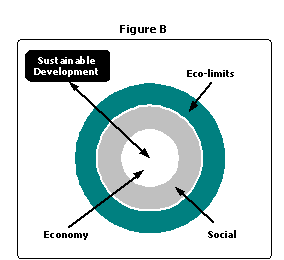
d. Another school has two wall charts.� One shows how the environmental, social and economic dimensions of sustainable development overlap, the other one with concentric circles.� This is used for raising questions about how to think about sustainable development.
�
|
|
�
�� |
�
�
It must also be encouraged by creating opportunities for them to put principles into practice.
�
CASE STUDY
One school builds recycling and reusing into every project. Every product a student makes from Year 7 onwards has to be capable of being disassembled. Before starting the making stage of any new project, students must visit the departmental �Eco-pod� where materials that can be recycled or re-used are stored. At the end of every project, all students who do not wish to take their products home with them have to take them to the Eco-pod so they are available for future students to use if this is practicable.
�
�
�Sustainability is a difficult concept for most people.� They have been brought up in such a disposable society � �If it is broken, buy a new one�.� We have to challenge this.� We keep the 3 planets approach in the backs of our minds the whole time: that is remembering that we way we live at the moment in the UK, we need three planets the size of The Earth to supply our wants and absorb our toxic emissions.�
Section D
�
When�s the best time to introduce sustainability to your students?
�
Although the Sustainable Design Award is intended for use with post-16 students, most teachers agree that the sooner their students are introduced to sustainability principles, the more likely it is that those principles will become part and parcel of their everyday thinking and therefore their designing and making.
�
�It is important that sustainability is a theme that runs the whole way through the curriculum.� You must build it in as an awareness early on from KS3 onwards.� Often primary schools are very good at it: we need to build on good practice in KS 1 and 2.�
�
Exercises such as the Kinder Egg, world map footprint with the big shoes and �What�s wrong with the World� (all described below) are good general things to raise peoples� awareness.� Although not linked to project work it is all part of building up a design vocabulary.� It is linked to their knowledge and experience of manufacturing, and understanding of the place of technology in society.
�
�
1.� Sustainable design in Key Stage 3
�
Some schools have taken the awareness exercises and design tools and rewritten them for younger children.� Some of them are in the KS3 strategy materials[2]. �See table below
�
|
Year |
Designing Sub-skill |
Name of activity |
Page |
|
7 |
Exploring ideas and the task |
Line-ups |
309 |
|
7 |
Exploring ideas and the task |
Product pairs |
310 |
|
8 |
Exploring ideas and the task |
Product footprint |
319 ff |
|
8 |
Exploring ideas and the task |
Winners and losers |
323 ff |
|
9 |
Exploring ideas and the task |
Inspirational products |
332 |
|
9 |
Exploring ideas and the task |
The Bigger Picture |
333 ff |
|
9 |
Exploring ideas and the task |
Design Abacus |
335 ff |
|
7 |
Generating ideas |
Designing for reuse and recycling |
352 |
|
8 |
Generating ideas |
Less is Best (Redesigning to reduce |
359 |
|
9 |
Planning |
Sustainable Materials |
397 |
|
9 |
Planning |
Product impact |
398 |
|
7 |
Evaluating |
That�s where I draw the line |
407 ff |
�
�
�
One school introduces the Design Abacus in Year 7, and the Eco-Design Web in Year 8.� Another school uses sustainable design in Year 9 as a way of selling the subject. It really appeals to the girls - is there a gender issue here?
�
One teacher advises, �Start as soon as possible in Year 7 � we look at training shoes and ask �Why do you want to buy this particular product or brand?�� We try to water down as much of the 6th form course as possible for the younger children and keep feeding it to them. For example we use Product Pairs with something simple such as yoghurts.� These are cheap and the children can eat them afterwards.�
�
Another teacher confirms this: �This approach needs to be started in Year 7 so that by 'A' level people do it without thinking. To get sustainable design embedded in departmental thinking and practice it is necessary to start in Year 7 and maintain it throughout the school. Again there is a need to expose younger pupils to really sexy, sustainable technology. Otherwise it is hard to convince students that this is worth doing.�
�
Almost every teacher advises it is best to keep raising the issues the whole time in KS3 whenever they can.� This is far more effective than dealing with it as a topic. �The best time is to introduce it subtly into KS3.� As the students come round to me I make sure that the issues come up in relation to the materials they are given and the projects they do.�
�
�
Case study from a school in Wales
�We are introducing it into KS3 as part of the Key Skills agenda.� The school is developing an intranet with four challenges, one of which is the Eco Challenge.� Students have to work in teams to identify an eco-problem and take practical action to solve it.� During this time they develop teamwork skills, planning skills and have opportunities to practice the use of number and IT. But it also means they have to understand basic issues of sustainable development. In Wales the new NC descriptors for KS3 will have sustainability written into them and to get a level 7 the student must have dealt with sustainability.��
�
�
2.� The Sustainable Technology Education Project
�
This was established by Practical Action for learning about sustainable development in Key Stages 3 and 4.� Practical has a range of written and online materials to teach sustainability at KS 3 and 4 � go to www.stepin.org which is the site of the Sustainable Technology Education Project, or contact Practical Action and ask for their resources list.
�
�
�
�
3.� Sustainable design in Key Stage 4
�
The exam boards are increasingly looking for an understanding of sustainable design at GCSE.� Sometimes this is couched in terms of �moral, social, cultural and environmental issues�.� If GCSE students deal with sustainability in their major projects it allows the teacher to give extra marks and prepares them for the question that usually comes up in the written exam.� There are always questions dealing with the market, recycling, packaging, waste etc.
�
Case studies
One teacher has had a really successful Y10 graphics project around Fair Trade (linked to Fair Trade fortnight). This has got the students to think about impact over the whole product life cycle.� In another school all Year 10 students do a project based on �Reduce Reuse Recycle�. In textiles they have a project on extending the life of something or reusing it. They use the Patagonia fleece as a case study. One person bought a gent's tweed suit from a charity shop and has developed a whole set of soft furnishings from it. They see reclaiming / reusing textiles as an obvious vehicle for learning about sustainable design.
�
�
One teacher says, �If you start with AS students you find they are already preoccupied with AQA assessment. It makes more sense to involve them in KS4 or even earlier so that they will see sustainability thinking as a natural part of designing and making.�
�
�
Case study:
One D&T subject leader was wondering how to stimulate interest in sustainable design among her GCSE students.� She took the best four students in Y10 and encouraged them to work for a Certificate in Sustainable Design. It helped to have an 'official company' involved. The key thing was that the Year 10s had ownership of the project.
�
�
Some other examples from schools
�
�
See images in separate file (image 3).
�
�
�
4.� Introducing it in Year 12
�
The general wisdom among all teachers who are committed to sustainable design is:
�
�
Every design decision, every product analysis, every discussion of topical events can be informed by thinking about sustainability.
�
Some teachers might have a presentation or use one of the design tools to lever students towards this frame of mind.� Others just use the odd minute or five in every lesson. Different approaches are described in the next section.�� But the key thing is Start on Day One.
�
Section E
�
How can sustainability be first introduced to your students?
�
The general wisdom is that you need to engage the students
�������� With their hearts as well as their heads
�������� Through looking at everyday products
�������� In an active way
�
�
1.���� Raising awareness
�
Case study 1 � Kinder Eggs
�
The Great Kinder Egg starter � this is a game developed by the Centre for Alternative Technology in Wales, and lots of schools say it is brilliant.
�
You give each group of students a Kinder Egg and cards with pictures of fields, lorries, mines, ships, factories etc.� Each group places the Kinder Eggs in the centre of the table and then builds up lines of cards to show what is involved in the production, use and disposal of the product.� So there are lines for producing the aluminium foil, the plastic toy, the cocoa, milk and sugar for the chocolate.� After a few minutes each group has lines of cards all over the table.
�
�Looking at the Kinder Egg raises questions in a very sharp way. Halfway through the penny drops. It comes as a real shock when students suddenly see how much goes into a pretty useless product � what an absolute waste of time, space, energy and resources the Kinder Egg is. This was one of the most powerful tools in the box.� A simple thing that every child has bought � they see that it has travelled so many miles � and cost the planet so much�
�
See images in separate file (image 4)
�
�
A variant of this exercise is Product Footprint which is a Year 8 �Exploring ideas and the task� exercise in the KS3 National Strategy folder (pages 319 � 322)
�
Case study 2 � Product Pairs
�
�Product Pairs works really well to raise awareness.�� Many schools use this exercise.� You have pairs of everyday products such as T-shirts, trainers, pencil cases, tea-bags, yoghurts etc.� In each pair one has good sustainability credentials: it might be organic, fair-traded, made from recycled materials, uses minimum waste, can be reused or remanufactured at the end of its life and so on.� The other has nothing particularly sustainable about it. You ask each student to decide which they would choose, and why.� Then tell them more about each product, and ask them to think again.
�
See images in separate file (image 5)
�
For more detail see http://www.sda-uk.org/sa4.html or pages 33 - 35 of SDA Teachers� Handbook.
�
�
Case study 3 � Line-ups
�
This takes 5 minutes and gets students off their bums and gets them to think at the same time.� You ask them to think about the last cup of tea or coffee they made, and then to think about three issues in turn.
For each of these three you ask them to physically line up across the room � at one end of the line are the goodies who do not waste energy, buy organic and fair traded products and compost their waste.� At the other end are the baddies who never think about these things.� Some people will place themselves in the middle.� After each round you invite students to say why they have placed themselves where they have, and discuss briefly the sustainability issues.
�
For more detail see http://www.sda-uk.org/sa3.html or pages 31 - 32 of SDA Teachers� Handbook.
�
�
�
�
Case study 4: Quick Questions
I just ask quick questions in class.� �Do you leave the tap running when you clean your teeth?� or �Do you leave the shower running to warm it up?�.� Most children clean their teeth or have showers � you must work inside their everyday experience.� Then discuss why this is important.� Some families have metered water � we discuss why.� We discuss how often people wash the car or use the washing machine.
�
�
�
More starter activities can be found on the SDA website: they are indexed with brief descriptions on http://www.sda-uk.org/starters.html.� The favourite ones for raising big issues are Belief Circles and The Bigger Picture.
�The Bigger Picture is very useful. I print the facts onto coloured card and each student is given a card. They then have to present to the whole group what is on the card, and the others react and the whole group discusses it. This is a real eye- opener. It makes them think. Sometimes they are shocked.�
Another favourite is What�s wrong with the world?
�
2.�� Learning through products
�
A good starting point is to analyse some so-called sustainable products that are not very good and see how they could be improved. In particular consider how might they be redesigned to make them more attractive aesthetically and more super- sustainable?� Many teachers build up a handling collection of good and bad products.� For example there is a hand-powered torch on the market that works better as a wrist-exerciser than a light source, or some rather naff sandals made from recycled tyres, both of which could be redesigned.
�
�
<images from information-inspiration website?>
�
�We take materials and processes as our starting point.� The students have to make decisions, and understand that they can�t use materials that carry a significant penalty.� They need to realise that you could use this but won�t.� They need to know that there are alternatives. They can still use hardwoods, meals and plastics in their own projects but they need to justify their decisions.�
�
Another teacher asks his AS group to each select a product that they really like, use everyday, and that they think is really well designed.� They each have to make a verbal presentation to the rest of the group, who can then ask questions and make comments.� The teacher uses this discussion to interject questions about social, economic and environmental impacts.� For example, one student brought in a cooking knife which is made from ceramics (the Kyocera knife).� This is self-sharpening and has a much lower embodied energy than a traditional steel knife.� There was a useful discussion on the concept of embodied energy and the teacher asked about everyday products for which the embodied energy could be reduced.� Another student brought in some commercially produced hamster litter that is made from shredded cardboard cartons.� The teacher asked if anyone knew who made them (nobody did).� He then referred them to www.greenbusinessnetwork.org.uk, which is an economically sustainable set of enterprises which are based on recycling and some of which employ people with severe learning difficulties.� Useful general purpose questions applicable to almost any product can be found in the SDA Teachers� Handbook on pages 45, 46 and 47.
�
Another teacher�s approach is to disassemble a product and then discuss each component from the perspectives of
This teacher uses information from the Eco-Indicator website www.pre.nl which gives comparisons for different materials.
�
�
Case study 4 � graphic products
�
One teacher has build up a collection of graphic products.� She has links with Blue Marmalade, a Scottish design consultancy that specialises in sustainable products.� They say about themselves:
�
�All Blue Marmalade furniture and products are deceptively simple. Their detailed design allows each surprising and exciting product to be created from a handful of components. All this means low waste products that are easily recycled. The bright and colourful nature of Blue Marmalade products means they fit seamlessly into the contemporary design landscape as well as being environmentally friendly.�
See http://www.bluemarmalade.co.uk/
�
Another teacher says: �In graphics GCSE we look at logos of popular product brands of e.g. trainers and discuss why they want those products.� We compare two different trainers (one much more expensive than the other) and again ask �Why?� when they are essentially the same products.�
�
A teacher in Wales got his AS students to analyse the logos of organisations interested in sustainability and asked them to decode the messages contained in the designs.
�
See images for E.doc in separate file (image 6)
�
�
�
Two excellent websites for finding interesting products are www.biothinking.com and www.informationinspiration.org.uk.� Teachers use these for getting information about the sustainability credentials of everyday products. These sites tend to focus on environmental factors.� Another site that looks at broader issues is http://www.ethicalconsumer.org/.
�
�
3.� Learning from outside speakers
�
The sad truth is that most students respond better to a new face, especially if that person is considered an expert.� Many students are introduced to sustainable design when someone from one of the partner agencies � Practical Action, the Centre for Alternative Technology, University of Loughborough � comes into school to run a half day or full day session.� Often these speakers use some of the awareness exercises listed above.
�
�Ann MacGarry from CAT came in and ran a session with our students and some from another school.� It was really good.� It lasted the whole day.� She did the Kinder Egg exercise: it is quite shocking the first time you do it.�� Teacher in Wales.
�
�
�
Case study 5 �� Student Study Days
�
Even better is taking the students to one of the study days
�
Each year the SDA organises a number of student study days at universities around England, and at the Centre for Alternative Technology in Wales.� The students are introduced to the nature and rationale of sustainable design, and are then set a design brief which they tackle in teams.� They learn how to use some of the design tools and towards the end of the day each group makes a presentation.� These days are very hands on, fast-paced, demanding and satisfying for the students who learn a lot in a short time.� They also enjoy working with outside tutors (often students doing design degrees, not old fogies like some of their teachers) and meeting students from other schools
�
Insert typical study day programme � Ian to do this
�
�The study day was mint.� �Fantastic.��
�
See images in separate file (image 7)
�
�
�
4.� To start with a presentation or not?
�
�I give a PowerPoint presentation with loaded questions � they are a bit contentious � and I try to get them to talk about global issues.� We use What�s wrong with the world? � there is a PowerPoint to go with this � and �The Bigger Picture�� We do a case study on the co-operative movement and talk about fair trade. When we have raised all the big questions I give them an essay �What is sustainable development?� I also use a PowerPoint on materials.�
�
This teacher believes that good practice in design is �� good communication (verbal and visual), problem solving and the ability to empathise with other people.� Of these basic transferable skills I would pick on empathy as the most important � it is important to be able to address problems from different viewpoints other than just their own.�� Copies of the PowerPoints can be downloaded from <stick onto SDA website and give reference>.
�
�
Case study 6: Presentation of global footprints
This is also available on <insert link to JP footprint.ppt assuming you have it somewhere>.� It is a short presentation on the concept of the footprint with some useful data on who causes the most damage to the planet, and how we (in the industrialised, northern countries) actually do it.� This can be linked to an exercise where students actually occupy a map of the world.
�
We started by putting a map of the world down and using very large shoes to indicate our footprints: the realisation that we need three planets to support our lifestyles as we are now (this was done with the whole of the 6th form by Ann MacGarry of CAT).
<images of footprinting / students on map of world>
�
See also the DfES KS3 National Strategy pages 319 � 322 Product footprint.� A good website for calculating your own footprint is http://www.myfootprint.org/
�
�
�
Case study 7 � The no presentation approach
�
Other teachers think it better not to start with too much information: �I do not use a presentation to launch sustainable design.� I prefer to use discussion as students have already picked up a lot of knowledge over time.� They are already aware of the issues over a whole range of subjects and they need to be able to put their knowledge into a design context.�� This teacher usually starts by discussing something topical such as water shortage, the price of petrol, or anything in the news that week.� The students can bring their own knowledge to the discussion, and it is this knowledge that provides the building blocks of more sustainable design.
�
�
�
5.� Using quotations
�
This teacher has a number of quotations in big letters around the room, and the students discuss them.
�
See images in separate file (image 8)
Section F
�
Choosing projects � what has been useful?
�
1.� The two key messages are:
�
�
The term �stakeholders� refers to anyone who has an interest in a product.� As well as the end-user, it could be someone who promotes, distributes or sells a product, or who is involved in servicing it or dealing with it at the end of life, or training people how to use it.� It is important to think beyond �clients� � after all the concept of client derives from commercial design and is often a bit artificial in a school-based designing context.
�
�
2.� Should all the students be working on the same context?
�
Some teachers direct the students towards a certain context in AS and allow free rein in A2.� Others give students a free choice throughout.� Others restrict the context in both years.
�
Case study 1
�It is good to have whole group working within a common theme or context, with the same client. Having a group theme increases motivation. The students discuss possible projects within the context and decide what they individually want to do. The staff can propose possible projects without the students losing marks provided they can justify what they are doing from a range of possibilities. Effectively we are working within the RRR context. One year everyone designed seating for a country park that is open to the public.� This year we are concentrating on signage and information for the client.�
�
Case study 2
Another school has collaborated with the East Anglia Wildlife Trust who is their client, and together they built a brief around a visitor centre - how could it be more sustainable? This year they are working with Habitat designing more sustainable products (the 'client' is the manager of a local branch. Actually they use the language of 'stakeholders').
�
Case study 3
A school in Wales that does a lot of work with Coed Cymru looked at furniture that could be made from recycled timber. They were designing and making products for a local bar using this wood.
�
�
Case study 4
An English school visited the House for the Future at the National Museum of Welsh Life in Cardiff. The architects describe this as an example of houses that eschew high-energy technology and embrace appropriate sustainable technologies within their contemporary design. The houses are designed to be 'affordable' and within the reach of the average house buying budget.� The students took as their starting point whether products on display inside the house could be designed more sustainably.
�
�
�
�
The most common pattern is to restrict the context in AS and allow students to choose their own contexts in AS.� Schools following the WJEC �A� level are given a good range of contexts, in which there are always good possibilities for sustainable design.� WJEC also accepts design contexts proposed by CAT.� Examples are:
�
�
�
�
3.� Should the students be restricted to SDA contexts?
�
The simple answer is �No� but �
�
Schools that choose one of the contexts from the SDA portfolio all report that the students find the support service really useful.� In one school the Year 12� students are introduced to the Practical Action projects. They either choose one of these (if it catches their imagination) or do their own project around the theme of more sustainable lighting.
�
Any student wanting to design a product for overseas context is strongly advised to work with Practical Action to make sure that the context is real and not sullied by ambiguous north-south relationships.
�
The SDA contexts have all been developed so that sustainability issues can be developed without too much input from the teacher.
�
�
�
�
�
�
�
Section G
�
Making the best use of resources
�
1.� Using the Teachers� Handbook
�
On the whole the teachers see the handbook as being for their own use.� One teacher said he read it all through and absorbed it all, and that has helped him to develop a �sustainable design state of mind�.
�
Some photocopy individual sections, such as the assessment criteria or some the checklists.� There are checklists on
These can be handed out at appropriate times.� The students keep them in their folders.� The brighter students will use them as and when they consider it useful: others will need the teacher to intervene and talk through the issues.�� Another teacher says: �I just leave the handbook around for anyone to delve into it�.
�
The handbook also has instructions for awareness and starter activities and design tools.� But everything in the handbook is also on the web, and a lot more else besides.
�
�
2.� www.sda-uk.org
�
Most teachers use the web, for the exercises, design tools and excellent links to examples of sustainable design.� Students like it � but you need to tell them about it first!
�
�
Case study 1:� monitoring the web
�
�I get my students to keep an eye on the SDA website and others that deal with sustainable design.� I ask them to report every few weeks to say what is new.�
�
Case study 2: Permanent access to the SDA site
�
This teacher has the SDA site running permanently in her design studio, and if nothing else is happening has it projected onto a screen.� If anyone want to find something out they simply go and use it.� By having it on the screen other students see things on the site just by being in the room at the same time.
�It�s really useful, because it encourages them to surf around and get into interesting areas like materials or good examples of sustainable design.� There are sexy, sustainable products there.� The other thing that�s good is that if someone asks me something I can tell them to look it up on the SDA site and maybe get another student to help.� It shares out the responsibility for learning. And I just love the Sustain-a-balls.�
�
Teachers also refer students to the website for briefs and contexts to stimulate thinking, and for the bigger picture issues.
�
�
Case study 3: using Practical Action�s main website
�
�The main Practical Action site is really good www.practicalaction.org.� We have a link with a school in Nepal and the headmaster from there was here to see if we could get involved in some projects.� We were interested in doing something on housing (using Practical Action�s Wall-to-Wall kit � see below), but the head was more interested in water issues.� There isn�t proper drainage, so the wells get contaminated and children get ill.� So we looked at the Practical Action website and looked at rainwater harvesting and filtration.� This was the theme for a lesson with the �A� level class.� The Nepalese headmaster was present throughout the lesson.�
�
Wall to Wall Design is an teaching pack that aims to help design and technology teachers tackle the subject of sustainability at key stage 3. It focuses on the cultural and environmental issues involved in building new homes and includes:
It costs �12.95 and is available from Practical Action.
�
�
3.� Help from the partners � Practical Action, Centre for Alternative Technology, University of Loughborough
�
Teachers use the partners for:
Section H
�
How can enthusiasm be maintained throughout a project?
�
Drip-drip-drip is the sustainable design teachers� motto.
�
�
1.� Lots of little prompts
�
All teachers recommend constant prompts when looking through a project.� �Lots of little prompts as the students build up their folders, rather than whole pages demanded on sustainability, lead to thinking and comments within the whole process. In this way the students see it as part and parcel of what they are doing. It is essential to have sustainability built right into the specification.�
�
Another teacher recommends nudging the students at regular intervals, using the SDA assessment sheets for formative evaluations.
�
�I go for the drip-drip-drip. Get a student (or students) to monitor www.biothinking.com or www.informationinspiration.org �and give a one-minute presentation on a Monday morning.� I also have slogans on the wall to remind people about sustainable design.�� Another teacher uses quotes from Victor Papanek� book Design for the Real World on worksheets as well as posters.
�
The Eco-design Handbook is an excellent resource, both in its construction and in the large number of products they showcase.� (The Eco-Design Handbook: A Complete Sourcebook for the Home and Office�by Alastair Fuad-Luke is published by Thames and Hudson � available at a good discount on Amazon.)
�
�We talk a lot about the three Rs (Reduce, Reuse, Recycle)� and maintain this as a theme throughout designing and again at end of project evaluations.� Throughout every project we raise these issues whenever we have one-to-one discussions with the students.�
�
�
Case study 1: Talking and sketching
�
One teacher sits down with his students and they sketch out ideas together as they talk.� He deliberately raises issues about the impacts of materials and processes throughout the discussions, both in terms of manufacturing, but also in use and disposal.� �It is just part of the way I think.�� The questions might concern how much embodied energy there is in a product or a particular material, how far it has to travel, can it be recycled easily, does it give rise to toxic emissions at any stage of its life cycle.�� This is in addition to discussion about aesthetics, suitability for purpose, cost etc.
�
�
Case study 2:� Using current events
�
�Whenever there is anything useful [for addressing sustainability] in the news I discuss it at the start of the lesson.� It might be about price rises on the buses, or some farmers trying to lease their land for wind farms.� Or about a new shop-cum-restaurant in town where they specialise in local food.� There is always something topical that we can link to sustainable design.� And it uses the knowledge and experience that they bring into the classroom.�
�
�We have just bought some ply.� It is Russian birch rather than Far Eastern.� We actually got it from a supplier in Nottingham. In class we discussed the availability, quality and how far it has been shipped � and whether I did the right thing in bringing it over from Nottingham [to south-west Wales].
�
�When a local farmer needed to cut down an oak tree we discussed the importance of this tree in the local ecosystem, and what we could do with the wood (we bought the timber from the farmer).� You need to relate sustainability to local things: you have to bring it back home.� It is not just about the Amazon rain forest: it is what we do here.�
�
Some teachers consider it easier to teach about sustainability in rural schools as people are closer to nature.� �Farmers � they know their trees, they know their grass, they know their rain.� They know all the bits.� They have to work with nature, not against it.�
�
�
�
2.� Using every opportunity
�
�Sustainability kind of invades everything.� When we look at materials it is not just performance, it�s about the sources and disposal of materials, about every single stage along the line. You need to be very pragmatic.� We get a lot of materials which otherwise would be industrial waste: this gives and opportunity to keep SD thinking in front of the students.� Recently we got some off-cuts from a tree that was being felled so we did a mini project on the tactile qualities of wood and other �waste� materials.� We are trying to use more sustainable materials � sustainable timber at KS 3 and 4, using recycled plastics (we are recycling them ourselves).� By using these and talking about them there is a drip feed effect.��
�
�
A resistant materials teacher takes a Year 12 Food Technology group for one lesson every fortnight and they look at packaging.� They do user trips on the packaging and then every student makes a PowerPoint presentation that covers social and environmental issues as well as ergonomics, manufacturing, health etc.� The TEP CD on materials and associated literature has really useful stuff.� (Called Materials Selection and Processing, this resource provides a freestanding knowledge base on materials. Based around material properties the visitor can establish related working properties and behaviour of a wide range of materials using material selection charts. Over 40 processes are detailed allowing the user to review materials applications, processes, design issues for woods, metals, plastics, ceramics and composites. The CD features tutorials and a case study with an accompanying ��Charts in action�� booklet and a teacher support booklet.� It is available from Teaching Resources, Unit 10, IO Centre, Waltham Cross, Herts, EN9 1AS.� Tel: 01992 716052.)
�
�
�Stick something about sustainability onto the back of a board so that when someone turns the board round it comes up.� �These messages are things like �24% of all freight traffic on the motorway is food�, �A return flight London-Madrid-London generates over a tonne of carbon dioxide emissions per passenger�,� �Today the government announced plans for a massive expansion in airport runways�, �The average rate of pay for a Chinese worker in a clothes factory is 25p per hour�, �What will you do today to save the world?�.
�
�During revision I bunged a lot of products onto the table, and asked the students to discuss them. Without any prompting they were discussing environmental issues, energy use and relating them to citizenship issues. It was not just looking at fitness for purpose�
�
�How do I maintain enthusiasm and make sustainability permeate a whole project? Once it�s built in at the start it is not a case of having to do anything.� It�s part of the thinking.� It�s inherent in the work.� If you want to do it successfully you have you have to get into that way of thinking and it permeates everything.� If you don�t get into that way of thinking it never, never takes off.�
�
�
�
3.� Getting in outsiders
One school gets Coed Cymru (a charity whose sole aim is to encourage the use of sustainable timbers) to come in and speak to the 6th form.� They talk about managed forests, more sustainable drying processes, low impact transport, how the wood and waste can be used.
�
Case study
�We have all sorts of people popping in and out, real links with live clients.� Last year for example we designed some equipment for CAT, for which we won an engineering award.� This year we are building a new bat house for the lesser horseshoe bats that are living in a pumping station halfway up a mountain.� This is sponsored by National Power.� In the past we have built water turbines and pumps.� We have developed instrumentation systems for recharging cells from wind and solar power sources. Now we are developing some equipment for Coed Cymru for turning sawdust into briquettes, and looking to Forest Schools for funding. This is all done in the lunch times.� Quite a lot of the students are heavily into sustainable engineering.�
Other sorts of people who can help might be from Eco-schools (see www.eco-schools.org.uk/), people from Wastewatch (www.wastewatch.org.uk/), someone involved in school travel plans (www.saferoutestoschools.org.uk and click onto School Travel Plans).� Often regional development agencies (RDAs) have teams that are promoting sustainable development, and they could put you in touch with local companies who are trying to practice sustainability.� The English RDAs are on www.englandsrdas.com/home.aspx.� In Scotland, Wales and Northern Ireland do to� www.scottish-enterprise.com, www.wda.co.uk and www.investni.com/index.asp respectively.
�
�
4.� Extra-curricular activities
�We are also using what we have learned in extra-curricular activities. There is much more freedom here without worrying about assessment criteria and the need to build up a folder. At present we are developing a human powered vehicle (HPV) and next year we are thinking about wind pumps.�
�
�We do a lot of engineering projects as extra-curricular activities.� At present we are developing a device for chopping up plastics so that we can use them for injection moulding.� We have developed a good relationship with SMILE plastics.� By asking the kids to bring in plastics for recycling we them thinking about different types of plastics.�
�
�
�
5.� Maintaining the right environment
The physical environment is crucial (see Section C)
�
�
6.� SDA � optional or compulsory?
�
Should the whole group be entered for SDA?� Should it be linked to ability of an individual student?� There are varying views on this. Some teachers simply tell the whole group that this is what they are doing.� One disadvantage of making it optional is that the teacher might need to spend extra time with the �sustainable designers� and this can cause resentment.� On the other hand, one could argue that all good design is sustainable design!
�
But one teacher warns against trying to lead everyone down this path: �Whether a student goes for it is linked to how the student thinks. Some are quite immature and rigid in their thinking.� They lack the flexibility to see beyond their own limited perspectives.� They can still do quite well in the exam without dealing with sustainability. Some students might not reach this level of maturity until they are 23 or 24: others will reach it when they are 15 or 16.�� Another teacher recognises that home and peer influences are very strong, and that the dominant teenage culture is one of high consumption and little thought for the future.
�
But is this an argument for, or against, teaching sustainability through design and technology?
�
�
7.� And finally a warning �.
�
One problem is that students can get too immersed in sustainability and that they spend too much time on it, especially at the research stage.� This is true for all projects � research is safe and non-committal for the students, and they can go for ever.� One teacher advises, �I insist on fairly frequent feedback from the client to keep things moving along.� This helps students not to waste time on folders doing things that get no extra marks, and helps to keep the folder work creative. I keep them to a minimum so that they can still get an 'A'.�
�
Another warns:� �The problem is the sheer volume of research that the students can do once they get stuck into sustainability. Since research accounts for only 10% of the marks it is important for the teachers to manage this very carefully and prevent the students from spending too much time on it. Alternatively we need to get the exam boards to allow more marks for research if students want to go into greater depth as regards sustainable design.�
�
�
Some other things to avoid:
�
Section I
�
Using the Design Tools
�
Details on the SDA design tools are on http://www.sda-uk.org/tools.html.
�
The most important message is:
�
1.� Do not assume a one�size fits all approach!�
�
Different teachers and indeed different students have had very different experiences with the tools.
�
Most teachers use the Eco-Design Web or the Design Abacus.� These are both qualitative tools.� Students use them for comparing products, developing criteria for their design specifications, comparing initial ideas and for end of product evaluations.� �We focus on the Abacus as a way into sustainable design because it is quick and easy to understand and use, it shows both the positive and negative aspects of a product and therefore what is in need of improvement.�
�
The EcoIndicator is a quantitative tool and is better for those students who are more fluent in maths.� One teacher reports: �The Eco-indicator is the most effective but you need to be good at maths to handle it. We use it for comparing products - good for evaluating ideas and for evaluating product, especially for comparing it with other similar products on the market.�
�
Another teacher only teaches one of the design tools, the Design Abacus, and makes sure that each student uses it at least once.� This enables her to give maximum marks for minimum effort. Obviously if the students want to use more tools, they can � but she does not push it.
�
A lot of students use the checklists, but perhaps these appeal more to verbal learners.
�
�
2.� Are the tools needed?
�
Most schools find them really valuable, but one teacher reports: �We don�t really use them much.� Different students learn in different ways, so my main method is discussing their projects with them.� We have to take different learning styles into account. Part of the magic of teaching �A� level is the close, personal and mature relationships with the students, so it is different with each person.�
�
Section J
�
Assessment issues
�
�
Teachers have mixed and even contradictory views on the SDA assessment criteria.� One teacher says: �The SDA assessment criteria are good in that they help to set a very high standard.�� But another says: �To begin with we looked at the SDA assessment criteria, but then we probably just forgot to use it with all the time constraints.� There is too much assessment generally.� It is not hugely relevant.�� A third says, �I use my discretion.� I do not let it become too onerous.� I hand out the SDA criteria so that the students can self-assess, but people do not necessarily read them �.� Perhaps the most common attitude is �The SDA assessment is OK � assessment is not my favourite part of teaching, but it is fine.��
�
�
The key advice is:
�
�
�
1.� Using the assessment sheets
�
Some teachers hand them out at the start of Y12 projects and go through them in class.� The students then self- assess and tick off boxes as they go along.� They then check what they have done against the criteria at the end of the project.
�
Case study � students learning from each other:�
One teacher brings her Y13 group into Y12 classes to talk about their projects and how they meet the assessment criteria. This was done before the October half-term. Another teacher hands out the assessment criteria right at the start of a project, and get the students to peer assessments with interim critiques throughout the projects (about every half term).� They sit round in the design studio and each student has a five minute slot.
�
�
�
2.� Using the criteria and checklists for formative assessment
�
Quite a few teachers spoke of the value of the assessment requirements as a useful tool for helping the students see what they needed to do in order to become more sustainable designers.� �We use these at the design stage as a formative tool. The students have the sheet and we look at it when setting objectives (pre-specification), after conceptualising solutions, when planning the making and for the product evaluation.�� Often they do this in 1:1 discussions.
�
There is also widespread use of the checklists � the three on economic, social and environmental issues, and the four on choosing a project, planning research, writing a specification and doing an end of project evaluation � as tools for formative assessment.� These are in the Teachers� Handbook (pages 49 - 52) and also on the SDA website.
See www.sda-uk.org/content/definitions/sustainissues.asp
�
�
3.� Using the SDA website
�
There is a student-friendly version of the assessment criteria on
http://www.sda-uk.org/sacheck.html.� Many teachers also refer their students to the Sustain-a-Balls pages on the SDA website for formative evaluations as they go through a project.� This works well with the highly motivated students who want to look things up and use them.
�
�
�
4.� Relating to the exam board assessment schemes
�
Most teachers find no conflict between the SDA criteria and those of the exam boards, but there are some issues.� One teacher complains that sometimes the exam board criteria mitigate against the SDA in that they are looking for a high standard of manufacturing, whilst we are trying to use reclaimed or recycled materials whenever possible.� Another says that the exam boards do not give credit for innovation or creativity.� Obviously the teacher has to do what they can to help the student get a good grade, and in this respect the SDA criteria take second place to the exam board�s materials
�
�
Section K
�
Extra-curricular help
�
The SDA partners � Practical Action, Centre for Alternative Technology and University of Loughborough provide help on
�
�
Comments from teachers:
�
�Taking groups to Loughborough has been immensely useful and again this alerts students to what is possible.�
�
�We have taken groups to CAT which was very worthwhile and useful. It is worth just being there even if it is not on an SDA course.� It is nice for the students to have external teachers.�
�
�The support we have had from Practical Action staff is amazing.� They really help the students understand what sustainable development is all about through the concrete experience of working on their projects.�
�
Sometimes it is possible for a member of the SDA team to come into a school
�
Case study
Ann MacGarry from CAT has been down to our school these last two years and done workshops.� This has been very helpful.� She comes in for a whole day and does the first half with the Year 12 students.� Then the second half is with cherry picked Year 11 students, either because they have shown an interest in D&T, or because they have just shown an interest in sustainability generally.
�
Section L
�
Culture in the department and the school
�
�
Central and obvious point:� the more the school is committed to sustainable development, the easier it is to teach sustainable design and vice versa.
�
1.� Encouraging a sustainability culture
�
So what is good practice in encouraging a positive sustainability culture in the school?
�
Case study 1 � a new ethos for the department
A new D&T subject leader wanted to establish his department as a leader in the region.� They felt that some other schools were well established in CAD-CAM and systems and control, or in the more aesthetic dimensions of design.� He proposed to his colleagues that they become a centre of excellence in eco design.� His colleagues agreed and they have gone from strength to strength.� The head invited the D&T team to make a presentation to the governors, and to other staff, on how the school can become a sustainable school.
�
�
�
Some schools have a strong emphasis on recycling in the school and in the department.� Some schools have an Eco Committee, usually set up and run by 6th formers, who plan recycling throughout the school and who are pushing the school towards Eco School status � see http://www.eco-schools.org.uk/.� One teacher says; �We have to practice what we preach.� We promote healthy eating rather than have Coca-Cola vending machines.� Local farmers provide milk and fruit for the school.� We discuss the reasons for this in PHSE lessons.�
�
But there is far more to sustainability than recycling.� What helps is a whole school commitment that covers use of energy and water, food, procurement and waste, buildings and grounds and so on.� In one school the D&T teachers are leading the school�s drive towards Eco School status.� It is one of the first secondary schools in the country to go down this line.� The head of D&T explains: "The school must lead with a positive example. We must put words into action. You have to have a big idea and live up to it."
�
�
2.� Linking with other external initiatives
�
As well as Eco School status there is a wide range of whole school initiatives such as Healthy Schools (see www.healthyschools.org/) which raises issues around food and water, Travel to School (lots of useful links from
www.teachernet.gov.uk/wholeschool/sd/focuson/sdtravel ��and recent moves around waste reduction (see http://www.wastewatch.org.uk).� These all provide doorways into more sustainable schools.
�
�
�
Case Study 2 � a sustainable school in Wales
At a school in Pembrokeshire, Wales the Deputy Head is a geography teacher and is really keen on this.� (There is a module in WJEC �A� level geography called �Sustainable Development� which he finds really challenging and interesting.)� He gives a lot of support to the D&T department�s efforts to teach sustainable design.� He is making a presentation to the whole staff and asking each department to report on how they are addressing sustainability issues � to map out how they are addressing it in their schemes of work.
�
The school already uses biomass (woodchip) for all its heating which has produced big savings as well as being environmentally better.� They want to start a plastics recycling system in the school. All the new buildings have movement-activated lighting, so you cannot leave the lights on for long.� They looked at water self-sufficiency but found that the lead content was too high for drinking water.� They buy organic food from local farmers.� They are working towards a zero-waste culture.
�
�
Case Study 3 � Support at county and national level
Pembrokeshire County Council has a sustainability policy and schools can get a Sustainable School Award at bronze, silver and gold levels.� See http://www.pgfl.org.uk/sustainable. The county has a full-time ESD officer.� To get the gold award the school needs to deal with all eight topics of healthy living, waste and litter reduction, biodiversity, transport, energy, community citizenship, water and global citizenship.� Also Estyn (the Inspectorate for Education and Training in Wales) has a guidelines for inspecting and evaluating education for sustainable development (see Estyn Newsbrief 18/02).� The Welsh Assembly has a wide ranging policy on ESD see: http://www.learning.wales.gov.uk/pdfs/esd-strategy-e.pdf
�
England is behind Wales with neither a requirement that schools are inspected for ESD, nor even a policy to promote ESD.� Although this is unlikely to change in 2006, the DfES is moving on ESD � see the new Action Plan on www.dfes.gov.uk/aboutus/sd/whatsnew.shtml.� There is also a consultation paper and web site on Sustainable Schools, both of which are due to appear in mid 2006.
�
�
�
Case study 4 � linking SDA with the school�s spiritual ethos
SDA is a vehicle for raising consciousness within the school and the Benedictine community that runs the school. Benedictine tradition and spirituality can be linked to sustainability: indeed sustainable development is seen as a natural way of thinking.� The D&T department sees SDA as something the department can contribute to the school development plan.� It is seen as a win-win: good education and the bursar is interested in sustainable development as a way of keeping costs down. This school is also investing in wood-chip powered heating.
�
�
Case study 4 � Getting Parents Involved.
One D&T Textiles teacher decided to involve parents. She sent letters home asking for old clothes that could be cut up (as opposed to being sent to a charity shop). She explained to the parents what it was all about. At a parents' evening it was clear that many of them were really excited about it. It helped that one girl has a dad who is project manager of a sustainable housing initiative. �There is often a lot of knowledge among parents about sustainable design � get these parents into school and the whole thing becomes more real.�
�
�
3.� Other ways of linking with internal initiatives
�
�
�
�
Case study 5 � linking sustainability to the international dimension
�The school has an environment week.� We are an international school.� The Deputy Head has just come back from visiting schools in Germany and is talking about the high level of recycling there.���� It is an essential component.� Also we have an international Eisteddfod for one week every summer, so there are many people out of school for this.� The remainder of the school has a week on suspended timetable, and the activities are organised on themes. For the last two years the theme has been on sustainability.
�
One group looked at sustainable housing, We used the Practical Action pack �Wall to Wall Design� and compared sustainable homes in Wales with Masai homes in Kenya. By the end of the week we had models.� Another group collected up old drinks cans and post-industrial waste aluminium.� They melted it down and used it to make a wide range of creative products.� This was linked to looking at the problems caused by extracting and processing new aluminium.
�
We get support from senior management.� There must be a senior manager who has responsibility for sustainability in the school.�
�
��������������������������������
4.� Departmental culture
Alas, there is a significant number of teachers doing the SDA who do not have support of senior management, or even their departmental colleagues.� Some have managed to take the whole team to the Centre for Alternative Technology in Wales. Those who have recommend it highly both for consciousness raising and for team building.
�
Others are working in isolation.� This is demoralising for many.� Others struggle on.� But one thing is certain � our future as a species depends on taking sustainability into the way we think and behave.� So if you are one of those who is unappreciated and isolated, please remember that you are not alone.
Section M
�
So what does it all add up to?
�
�
It is not just about high flyers doing well, nor the number of people actually getting the SDA. It is more about some people who are not particularly strong getting a C grade, because they are motivated by the SDA and the thinking behind it.� At the top end it has added that something extra that moves students from B to A. SDA has had a positive effect on exam results.
�
Success is when the students really get into it and become much more aware of recycling possibilities and how emissions could be reduced, that things can be redesigned and change can be for the better.� When this comes out as you talk to the students you know that there is good practice.
�
Students will become aware of the moral responsibilities of designers.
�
The excitement of SDA enthuses teachers. It is a new approach. It has pulled up the whole quality of designing and making.
�
It has made the students move away from self-centredness through having to relate to client in real situation.
�
There has been an interesting effect on the client who is now thinking much more about sustainable development. This is one of the unexpected consequences. It is easier for people who are thinking about SD (i.e. our students) to get into the minds of those who are not (i.e. the client) than it is the other way round - that is if the client is not thinking about sustainability it is harder for him to understand what we are on about. Our understanding of this has helped to make for useful interaction between the students and the client. He is now enthusiastic about sustainability. The school can change the way that people think. The client has realised that the more cost-effective solutions to problems are also the more sustainable. Often the students are in front of the client - success is when the client learns as a result of the contact with students.
�
Doing the SDA has had a good effect on teamwork and developing teamwork skills. It helps to nudge things along and create virtuous circles of activity and reflection.
�
Signs of good practice are when our students (designers of the future) ask first of all,� "Should we be making this at all?". If the answer is "yes" then they think about every aspect of environmental design. The social and economic issues are harder to deal with - but the students need to ask, "How will this product affect our lives? How will it affect the lives of the people who make it, who live in the area, who supply the materials." This needs to be a constant questioning.
�
�
Good practice is good communication (verbal and visual), problem solving and the ability to empathise with other people.� Of these basic transferable skills I would pick on empathy � it is important to be able to address problems from different viewpoints other than just their own.
�
Sustainable designers prioritise their specifications slightly differently from others.� They are not so superficial.� They think and ask, �Is there a real need for this?�� They think beyond doing any old spurious things you can get marks for. Students with insights into sustainability will look at performance criteria such as what happens to the product over its whole lifecycle and how easy it is to maintain.� A sustainable designer is altogether a more thoughtful designer.
�
Sustainability is a fundamental background awareness.� It has to be part of their design vocabulary.� Sustainability is not something you can bolt onto a project.� It has to be a mindset when you begin designing.� It will influence everything.� All materials, research, design decisions will be influenced by the mindset.�
�
Our problem is that awareness is high, but how can this be translated into practical action?� We have to practise what we preach, so we are looking at small-scale electricity generation.
�
The well-educated student�?� When they come round to the next project they immediately identify ways of looking at sustainable materials or systems without being prompted to do so.� Some people take this on easily and immediately look at sustainable principles � others have to be guided into it and reminded what it is.� They need to be able to transfer skills and knowledge beyond the immediate project.
�����������
Success is seen in what the children do � it is not just a matter of awareness. It is how they run their lives differently as a result of what they have learned.
�
�
�
[1] See �http://www.sda-uk.org/toolsi.html or� page 62 of SDA Teachers� Handbook
[2] DfES (2004)� Key Stage 3 National Strategy� Foundation subjects: design and technology.� London, DfES